Signals
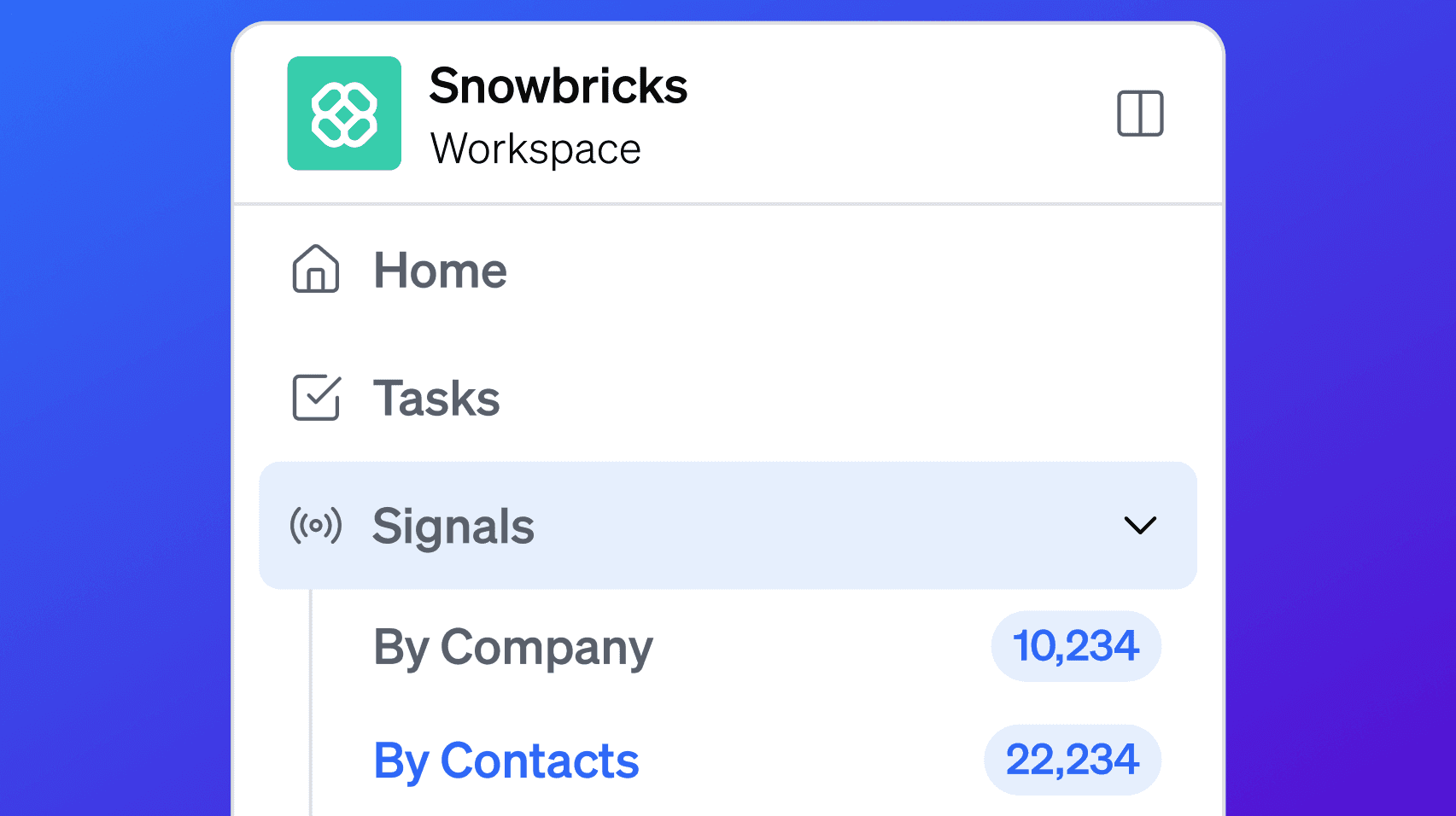
View by Contact
View by Contact shows person-level signal activity in one place, helping you see which target contacts are engaging with you.
This is where 1eyeᴬᴵ shows you the people behind your GTM signals. Each contact sits inside a company context, so your team can understand both the person and the business behind the activity.
Use View by Contact when you want to identify active target contacts, evaluate persona fit, review their company, understand their signal history, and decide who should be enriched, added to a list, or moved into a campaign.
What View by Contact is for
B2B GTM still needs people.
A company may show interest, but your team eventually needs to know:
View by Contact helps answer that.
It organizes activity around the person so your team can see:
Which target contacts are active
What signals each contact generated
Which company each contact belongs to
Whether the contact matches your personas
Whether the company matches your ICPs
What pages, posts, forms, messages, replies, or engagement are connected to the contact
Whether the contact should be added to a target list or campaign
How View by Contact works
1eyeᴬᴵ collects signals across channels and groups them by contact when person-level context is available.
A contact can show activity through:
Website visits
Tracked forms
LinkedIn engagement
Email opens
Email replies
LinkedIn connection activity
LinkedIn messages
iMessage reads
iMessage replies
Response intent
Persona evaluation
Related company activity
When 1eyeᴬᴵ identifies a contact, it creates or updates the contact signal record.
Your team can then review the contact, inspect the signals, evaluate persona fit, check company context, and decide what to do next.
What you can see in View by Contact
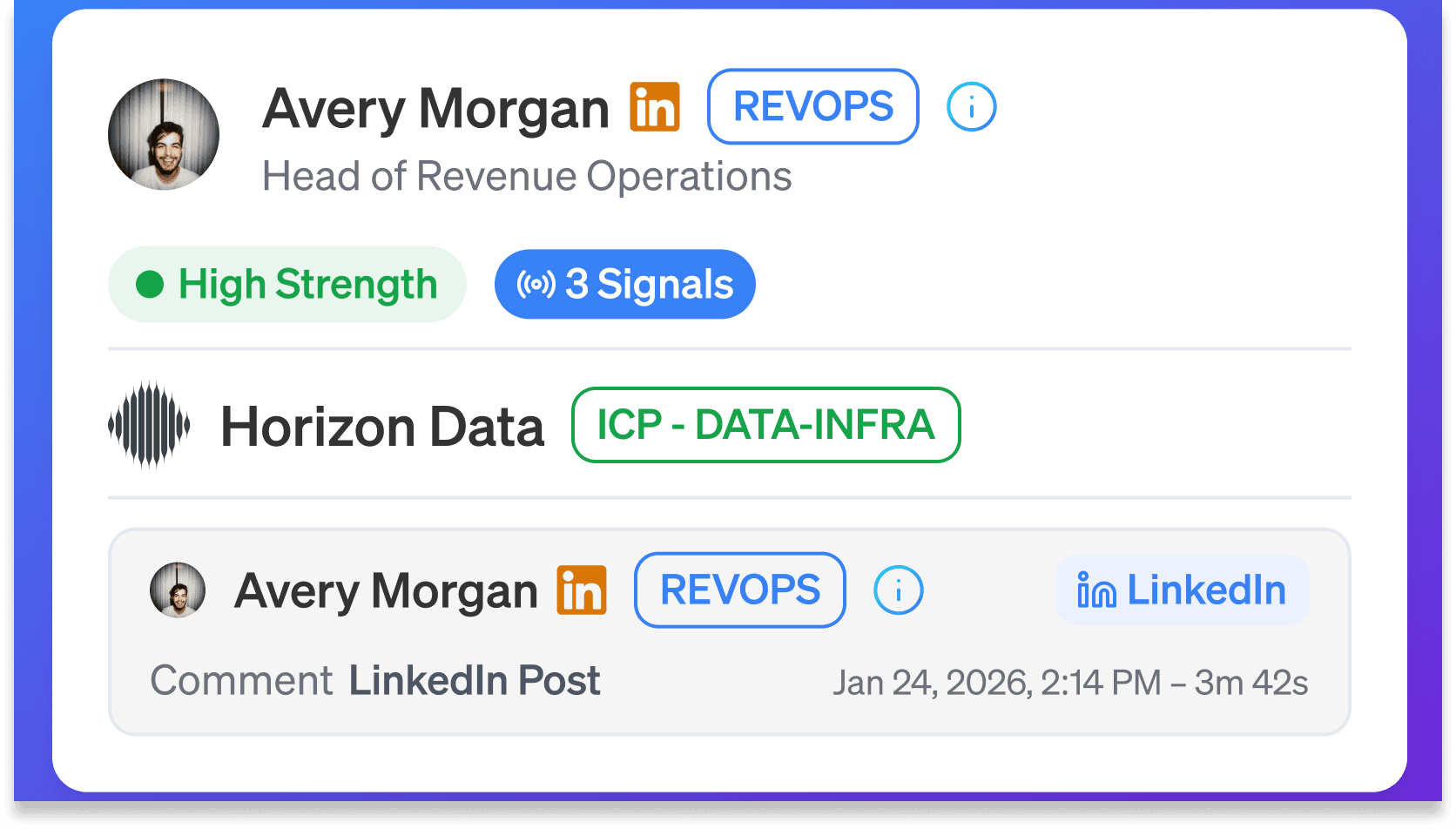
Each contact card may include:
Contact name
Job title
Company name
Company domain
LinkedIn profile
Latest signal
Signal count
Persona match badge when available
Company context
ICP match when available
Signal timeline in the side panel
Contact enrichment when available
Example:
Field | Example |
|---|---|
Contact | Avery Morgan |
Title | VP Revenue Operations |
Company | Northstar Analytics |
Company domain | northstaranalytics.com |
Latest signal | LinkedIn reply |
Signal count | 6 |
Persona match | REVOPS |
Company ICP match | ICP - B2B-SAAS |
This gives your team a fast person-level view of who is engaging and whether they are worth follow-up.
Contact signals
A contact signal is any activity connected to a person.
Contact signals may include:
A contact visiting your website
A contact viewing a pricing, demo, product, or contact page
A contact submitting a form
A contact engaging with your LinkedIn company page
A contact engaging with a connected user’s LinkedIn account
A contact opening or replying to an email
A contact accepting a LinkedIn connection request
A contact replying to a LinkedIn message
A contact reading or replying to an iMessage
A contact matching one of your personas
A contact showing positive, neutral, or negative intent
Contact signals help your team understand person-level intent.
Every contact includes company context
View by Contact is powerful because the contact is not shown in isolation.
Each contact can include company context so your team understands the account behind the person.
A contact record may include:
Contact details
Name, title, LinkedIn profile, email, phone number, and role context when available.Company details
Company name, domain, LinkedIn, location, industry, employee count, revenue, and founded year when available.Firmographic context
Company size, category, geography, industry, business model, and other account-level details.Technographic context when available
Technologies, tools, platforms, or systems associated with the company when available.Signal history
Website visits, LinkedIn engagement, email activity, iMessage activity, responses, forms, and intent.Persona evaluation
Whether the contact matches one or more personas in your Knowledge Base.ICP evaluation
Whether the contact’s company matches one or more ICPs in your Knowledge Base.Next action context
Enough information to decide whether to enrich the contact, add them to a list, launch a campaign, or follow up.
The goal is to connect person-level activity with company-level fit.
Why contact-level signals matter
In B2B, companies matter, but people create conversations.
A company may be active, but a relevant target contact gives your team a direct path to action.
Contact-level signals help you:
Find the people behind account activity
Prioritize contacts who match your personas
Understand which people are engaging across channels
Identify who opened, replied, accepted, read, or submitted forms
Build better target contact lists
Personalize outreach by role and activity
Launch campaigns with stronger context
Follow up with the right person at the right time
Persona evaluation
1eyeᴬᴵ evaluates contacts against your personas.
When a contact signal comes in, 1eyeᴬᴵ checks whether the contact matches one or more personas in your Knowledge Base.
If the contact matches, 1eyeᴬᴵ may show a persona badge on the contact card.
Example:
The persona badge helps your team quickly understand why the person may be relevant.
What 1eyeᴬᴵ may use for persona evaluation
1eyeᴬᴵ may evaluate contact fit using context such as:
Job title
Seniority
Function
Department
Company
LinkedIn profile context
Signal activity
Message activity
Response intent
Persona definitions from your Knowledge Base
The goal is not just to identify a person. The goal is to decide whether that person looks like a good target contact.
Persona match explanation
When a contact matches a persona, 1eyeᴬᴵ may show an explanation.
Example:
Use the explanation to validate whether the match makes sense before adding the contact to a list or campaign.
Target Page badge
When a contact visits a URL that matches an active Target Page in your Knowledge Base, 1eyeᴬᴵ shows a Target Page badge on the signal, for example:
The badge appears next to the page visit inside the contact's signal timeline, so your team can immediately see when a contact hit a high-intent page without reading every visited URL.
Visits to URLs that do not match a Target Page still appear, but only as a generic Page signal without the badge.
Use the Target Page badge to quickly scan a contact's activity for the pages that matter most, and to spot when the same person keeps returning to a high-intent page like pricing or demo.
Show Personas Only
Use Show Personas Only when you want to focus only on contacts that match your personas.
When enabled, View by Contact filters the list to contacts that 1eyeᴬᴵ has evaluated as persona matches.
Use this when you want to:
Reduce noisy contact activity
Focus on best-fit people
Review high-priority contacts
Build cleaner target contact lists
Prioritize contacts for campaigns
Spend less time reviewing poor-fit activity
For example, if Snowbricks only wants to review contacts who match RevOps, Data, GTM Systems, Sales, Marketing, AI, or Founder personas, Show Personas Only helps narrow the view.
Persona filter
Use the persona filter when you want to view contacts that match a specific persona.
For Snowbricks, example persona filters may include:
Revenue Operations Leader
Head of Data
VP Sales
VP Marketing
GTM Systems Leader
AI Transformation Leader
Founder or CEO
Use the persona filter when you want to answer questions like:
Which RevOps leaders are active?
Which Heads of Data engaged recently?
Which VP Sales contacts replied?
Which personas are generating the most signals?
Which role should we build a campaign for?
Show Personas Only gives you all persona-matched contacts.
The persona filter lets you focus on one specific persona.
Company context inside contact view
View by Contact also shows the company connected to each contact.
This matters because a contact is more valuable when their company is also a good fit.
For each contact, review:
Company name
Company domain
Industry
Location
Employee count
Revenue when available
ICP match when available
Related company signals
Other contacts at the company when available
A contact with a strong persona match at an ICP-matched company should usually be prioritized before a contact with weak company fit.
ICP context for contacts
Even though View by Contact is person-level, company fit still matters.
A contact may match a persona, but their company may or may not match your ICP.
For example:
Contact | Persona match | Company | ICP match | Priority |
|---|---|---|---|---|
Avery Morgan | REVOPS | Northstar Analytics | ICP - B2B-SAAS | High |
Taylor Reed | VP-SALES | Local Retail Group | No ICP match | Lower |
Jamie Patel | DATA | Horizon Data | ICP - DATA-INFRA | High |
The best contacts usually have both:
Persona fit
Company ICP fit
Associated company signals
A contact may be connected to broader company activity.
For example, the contact’s company may have:
Multiple website visits
Multiple active contacts
LinkedIn engagement
Form activity
Email engagement
iMessage engagement
Positive replies
ICP matches
Use associated company signals to understand whether the contact is part of a larger account-level pattern.
Contact signal timeline
When you select a contact, the side panel shows their signal timeline.
The timeline helps you understand what happened and when it happened.
A contact timeline may show:
Page visits
Form activity
LinkedIn activity
Email opens
Email replies
LinkedIn connection requests
LinkedIn messages
iMessage reads
iMessage replies
Response intent
Persona match activity
Signal dates and times
Use the timeline to understand whether the contact is lightly active or clearly engaged.
Reading a contact card
When reviewing a contact card, look at six things:
Contact identity
Is this a real person? Does the name, title, and LinkedIn profile look right?Persona fit
Does the contact match one of your target personas?Company fit
Does the company match one of your ICPs?Signal strength
Did the contact generate one signal or multiple signals?Signal quality
Did the contact visit high-intent pages, engage on LinkedIn, reply, read an iMessage, or submit a form?Next action
Should this contact be enriched, added to a list, moved into a campaign, or followed up with?
The best contacts usually have persona fit, company fit, and recent activity.
Search contacts
Use search to find a specific contact, company, domain, title, or keyword.
Examples:
Search is useful when you already know what person, company, or role you want to review.
Filter contacts
Use filters to narrow the contact view.
Filters may include:
Company
Contact person
Persona
Type
Date range
Target Page
Use filters when you want to focus on a specific signal set.
Filter by company
Use the company filter to review contacts connected to a specific business.
Example:
This helps you see active people connected to one company.
Filter by contact person
Use the contact person filter to review a specific contact.
Example:
This is useful when a contact is active and you want to inspect their signal history.
Filter by persona
Use the persona filter to view contacts that match a specific persona.
Example:
This is useful when you want to focus on one role before building a target list or campaign.
Filter by type
Use the type filter to narrow contact signals by activity type.
Types may include:
Page
Form
LinkedIn
Email
iMessage
Response
Persona
ICP
Examples:
Type | Use it when you want to see |
|---|---|
Page | Contacts visiting tracked website pages. |
Form | Contacts connected to tracked form activity. |
Contacts engaging through LinkedIn. | |
Contacts connected to email activity. | |
iMessage | Contacts connected to iMessage activity. |
Response | Contacts with replies or response activity. |
Persona | Contacts evaluated as persona matches. |
ICP | Contacts whose companies were evaluated as ICP matches. |
Use type filters to separate broad activity from high-intent activity.
Filter by Target Page
[Screenshot: contact signals filter panel — URL Filter, Target Pages (Max 5) selected]
The filter panel includes a URL Filter with two options, on top of the standard Company, Contact Person, Persona, Type, and Date Range filters:
Option | What it does |
|---|---|
All URLs | Include signal activity from any page on your website. |
Target Pages (Max 5) | Limit results to contacts who visited specific pages. Enter up to 5 URLs to focus on high-intent pages such as pricing, demo, or product pages. |
When entering URLs under Target Pages:
Add up to 5 URLs.
Enter a full URL or domain path, for example
https://domain.com/contact-usordomain.com/login.Use
*as a wildcard, for exampledomain.com/*change-stackordomain.com/*change-stack*agents.
As you type, if the URL matches a page already configured as a Target Page in your Knowledge Base, 1eyeᴬᴵ shows a suggestion with the Target Page's name and short name, for example:
https://snowbricks.io/ Homepage [Home]
Select the suggestion to use the saved Target Page instead of typing the raw URL — this applies the page's configured Match Type (Exact Match, Contains, Starts With, Ends With) automatically and keeps the filter labeled consistently with the Target Page badges shown on signals. If the typed URL doesn't match a configured Target Page, it's still used as a plain custom URL condition, wildcards included.
For each URL, you can also set:
Field | What it does |
|---|---|
Visit Count | Filter by number of visits, e.g. Equal to, Greater than, or Less than a given count. |
Total time spent | Filter by total time spent on the page, e.g. Equal to, Greater than, or Less than a given duration. |
Select + Add to add another URL condition, up to the 5-URL maximum — for example, filter for contacts who visited the Pricing page at least 5 times and spent real time on a specific blog post. Each condition appears as a chip below the panel, showing the page name (or URL), match type, and thresholds, with an x to remove it.
Example:
Pricing · Exact Match · visits ≥ 5 · time ≥ 12m 12s
Select Apply to run the filter, or Clear to reset it.
Use Target Page filters when you want to answer questions like:
Which contacts visited Pricing more than once?
Which contacts spent real time on the Demo page, not just a quick bounce?
Which contacts are showing repeated interest across two or more high-intent pages?
Filter by date range
Use date range to review contacts active during a specific period.
Examples:
Today
Yesterday
Last 7 days
Last 30 days
Current campaign window
After a product launch
After a LinkedIn campaign
After an email campaign
During an event or webinar
Date filtering helps your team connect contact activity to GTM moments.
Sort contacts
Use sort to change the order of contacts.
You may sort by:
Most recent activity
Highest signal count
Contact name
Company name
Created date
Updated date
Use sorting to prioritize the contacts that matter first.
For example, sort by most recent activity when your team wants to act quickly.
Sort by signal count when your team wants to find contacts with repeated activity.
Export contact signals
Use Export CSV to download the contacts in the current contact view.
The export gives you a contact-level CSV, including the contacts shown in the view and the available contact details, company details, signal context, persona match information, ICP match information, and related fields.
Export is useful when you want to:
Share active contacts with your team
Review people in a spreadsheet
Send contact activity to RevOps
Build campaign audiences
Compare signal activity over time
Review persona-matched contacts offline
Create target contact lists
Before exporting, use filters to clean the view.
Example export workflow:
Open Signals → View by Contact
Turn on Show Personas Only if you only want persona-matched contacts
Filter by a specific persona if needed
Filter by recent activity
Sort by signal count or recency
Select Export CSV
This downloads the contacts from the current view, so filter first if you want a focused export.
Recommended workflow: find active persona contacts
Use this workflow when you want to identify high-fit contacts.
Open Signals → View by Contact
Turn on Show Personas Only
Review contacts with recent activity
Check signal count
Review the latest signal
Open the contact timeline
Read the persona match explanation
Check the contact’s company and ICP fit
Add strong contacts to a target contact list
Prepare a campaign or follow-up
This workflow helps your team move from signal activity to contact prioritization.
Recommended workflow: build a target contact list
Use this workflow when you want to build a list from contact signals.
Open Signals → View by Contact
Filter by persona
Filter by date range
Sort by signal count or recent activity
Review contact cards
Open timelines for high-priority contacts
Remove poor-fit contacts
Check company ICP fit
Add relevant contacts to a target list
Launch or prepare a campaign
This workflow helps you build lists from real activity instead of static research.
Recommended workflow: investigate one contact
Use this workflow when a contact looks interesting.
Search for the contact
Open the contact card
Review title and persona fit
Review company and ICP fit
Open the signal timeline
Check which pages, channels, messages, or replies created signals
Review response intent when available
Decide whether to enrich the contact
Add the contact to a list
Follow up with context
This workflow helps your team understand the person before taking action.
Recommended workflow: act on high-intent contact activity
Use this workflow when a contact shows strong intent.
Open View by Contact
Filter by recent activity
Filter by Form, LinkedIn, Email, iMessage, or Response signals
Look for repeated signals
Review whether the contact matches a persona
Review whether the company matches an ICP
Add the contact to a target list
Add the company to a target company list if needed
Launch a campaign with signal context
This workflow helps your team act on the contacts that are most likely worth attention.
How View by Contact connects to target lists
View by Contact is one of the best places to build target contact lists.
You can use it to find contacts that are:
Active
Recently engaged
Persona-matched
Connected to ICP-matched companies
Repeatedly showing signals
Engaging across multiple channels
Showing high-intent behavior
Responding with positive or useful intent
Once you find relevant contacts, add them to a target contact list.
Then launch a campaign or follow up based on the signal context.
How View by Contact connects to campaigns
Contact signals can help you launch better campaigns because your team knows why the person is relevant.
Instead of sending generic outreach, your team can use context such as:
Contact visited pricing
Contact engaged on LinkedIn
Contact submitted a form
Contact opened an email
Contact accepted a LinkedIn connection request
Contact read an iMessage
Contact replied with positive intent
Contact matches a specific persona
Contact works at an ICP-matched company
This gives campaigns a stronger starting point.
Best practices
Use Show Personas Only
This removes noise and focuses the view on contacts that match your target personas.Use the persona filter for role focus
Filter by one persona when building a campaign for a specific role.Check company fit
A persona-matched contact at an ICP-matched company is usually more valuable.Prioritize recent activity
Fresh contact signals are usually more actionable than old ones.Look for repeated signals
Multiple signals from the same contact usually matter more than one isolated signal.Review high-intent signal types
Form, response, email reply, LinkedIn reply, iMessage reply, demo activity, and repeated engagement should get attention.Read the persona explanation
Use the explanation to confirm why 1eyeᴬᴵ matched the contact.Review the full timeline
The timeline helps you understand the contact’s journey before follow-up.Enrich only relevant contacts
Use persona fit and company fit before spending enrichment credits.Add exclusions when needed
If the contact’s company should not be targeted, add the company to Exclusions in your Knowledge Base.Build lists from signals
Do not let active contacts sit unused. Move good-fit people into target lists.Use exports after filtering
Export only after narrowing the view to relevant contacts.Keep your Knowledge Base current
Better personas, ICPs, and exclusions create better contact signals.Use Target Page filters for high-intent follow-up
Filter by visit count and time spent on Target Pages like pricing or demo to prioritize the contacts showing the strongest buying signal.
Troubleshooting
I do not see any contacts
Check:
Signals are flowing into your workspace
Person-level identification is available
Campaigns are active if you expect conversation activity
LinkedIn accounts are connected if you expect LinkedIn activity
Mailboxes or iMessage lines are connected if you expect message activity
You are viewing the correct date range
Filters are not hiding results
I see contacts but they are not relevant
Try:
Turning on Show Personas Only
Filtering by a specific persona
Tightening your persona definitions
Reviewing the contact’s company fit
Adding company exclusions
Filtering by signal type
Reviewing only recent activity
A contact does not have a persona badge
This may mean:
The contact does not match your current personas
1eyeᴬᴵ does not have enough context yet
Your persona definitions need to be updated
The contact is outside your target roles
Review the contact and update your Knowledge Base if needed.
A contact visited a Target Page but I don't see the badge
Check:
The Target Page is set to Active in your Knowledge Base
The Match Type covers the visited URL
The URL was entered correctly when the Target Page was created
The visit happened after the Target Page was created
Persona matches look wrong
Review your personas in the Knowledge Base.
Check:
Persona descriptions
Job titles
Seniority
Functions
Departments
Buying roles
Use cases
If personas are too broad, you may see noisy matches.
If personas are too narrow, you may miss good contacts.
I see contacts but their companies are not a fit
Check the company context.
Try:
Reviewing ICP match
Filtering by ICP in View by Company
Adding poor-fit companies to Exclusions
Tightening ICP definitions
Building lists only from contacts at ICP-matched companies
I see company signals but no contact signals
This can happen when company-level identification is available but person-level identification is not.
Not every signal can be tied to a specific person.
Contact timeline looks empty or incomplete
Check:
Filters are not limiting the timeline
The selected contact has recent activity
The signal source is supported
Activity has had time to process
The contact is connected to the right company
Export is too noisy
Before exporting:
Turn on Show Personas Only
Filter by persona
Filter by type
Select a recent date range
Sort by signal count or recency
Export only the focused view
A contact should not be targeted
If the contact’s company should not be targeted, add the company to Exclusions in your Knowledge Base.
Use exclusions for:
Your own company
Existing customers
Competitors
Vendors
Partners
Agencies
Poor-fit companies
FAQ
What is View by Contact?
View by Contact shows signal activity grouped by person, so your team can understand which contacts are engaging and whether they match your personas.
How is View by Contact different from View by Company?
View by Contact focuses on person-level activity. View by Company focuses on account-level activity.
Does View by Contact also show the company?
Yes. Each contact includes company context when available, so your team can evaluate both person fit and company fit.
What is a contact signal?
A contact signal is activity connected to a person, such as website activity, LinkedIn activity, email activity, iMessage activity, form activity, response activity, or persona evaluation.
What does Show Personas Only do?
It filters the contact view to show only contacts that 1eyeᴬᴵ has evaluated as matching your personas.
What is the persona filter?
The persona filter lets you view contacts that match a specific persona from your Knowledge Base.
Can I see company information for a contact?
Yes. Contact cards may include company name, domain, industry, location, employee count, and ICP match when available.
Can I see firmographic information?
Yes. Firmographic details may appear through the contact’s company context when available.
Can I see technographic information?
Technographic context may be available through the contact’s company when 1eyeᴬᴵ has access to it.
Can I export contact signals?
Yes. Use Export CSV to download the contacts from the current contact view.
What is included in the contact export?
The export includes the contacts shown in the current view and the available contact details, company details, signal context, persona match information, ICP match information, and related fields.
Should I filter before exporting?
Yes. If you want a focused export, apply filters first. For example, turn on Show Personas Only, filter by a specific persona, or select a recent date range before exporting.
What should I do with a contact that has strong signals?
Review the contact, check persona fit, inspect the timeline, review company fit, enrich if needed, add the contact to a target list, and prepare a campaign or follow-up.
Why do some contacts have no persona match?
They may not match your personas, or there may not be enough context to evaluate them as a match.
Why does a contact matter if the company is not an ICP match?
The contact may still be useful, but company fit should guide prioritization. In most cases, a persona-matched contact at an ICP-matched company is stronger.
How do I improve contact signal quality?
Keep personas sharp, keep ICPs updated, add exclusions, connect the right channels, use filters, and review recent activity first.
What is a Target Page badge?
It's a badge shown on a contact's signal when the visited URL matches an active Target Page from your Knowledge Base, such as Target Page - Pricing.
Can I filter View by Contact by Target Page?
Yes. Use the Target Page Search panel inside Filters to filter by one or more Target Pages, with conditions on visit count and total time spent.
Next step
Next, go to ICPs to understand how 1eyeᴬᴵ uses target company profiles to evaluate companies and power better targeting.